Environment
Noise, layout, tools, pacing, interruption, and the physical conditions around action.
An emerging interdisciplinary field
The study and design of conditions that let preserved ability become usable action.
People can possess an ability without being able to access it reliably when it is needed. Access Architecture examines the conditions that make ability available, unstable, fragile, or difficult to recover.
Ability describes what a person is capable of doing. Access describes whether the conditions currently allow that capacity to become usable action.
A person may reason clearly, explain a solution, demonstrate expertise, or perform at a high level in one context while remaining unable to reliably initiate, sustain, switch, resume, organize, or complete action in another.
Visible competence is real. It is not proof that equivalent access is stable, available on demand, or sustainable over time.
The field examines
Access is shaped by interacting conditions. The relevant barrier may change over time, and a support that works once may not remain a fit.
Noise, layout, tools, pacing, interruption, and the physical conditions around action.
Fatigue, pain, sleep, workload, attention, initiation, recovery, and physiological state.
Communication, trust, co-regulation, support, credibility, and shared responsibility.
Fluctuation, episodic disability, changing needs, task resumption, and reliability.
Workplaces, institutions, accommodations, policies, and their assumptions.
Conditions that preserve context, reduce access burden, and help ability become action.
Publication 01 · August 16, 2026
This paper establishes the field’s central distinction and introduces an initial vocabulary for unstable access, including the Recognition Paradox, access volatility, accommodation drift, access fragility, context collapse, re-entry failure, and physiological access.
Books
These books bring the field's central questions into lived experience and everyday language.

New release · 2026
A short book about the gap between knowing what needs to be done and being able to reliably act.
Buy on Kindle →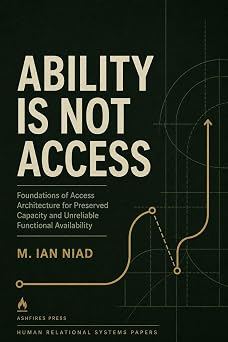
Kindle book · 2026
The foundational paper in ebook format, introducing the distinction between preserved ability and reliable functional access.
Buy on Kindle →Working vocabulary
These concepts are part of an evolving framework. They name patterns often experienced but poorly described by static models of ability and accommodation.
Visible competence can reduce the perceived need for support.
The conditions that make capacity usable change over time.
A once-effective support loses fit as needs or conditions change.
A hard-won accessible state is comparatively easy to disrupt.
Enough task context is lost that meaningful reconstruction is required.
Previously accessible work cannot be reliably resumed after disruption.
Where the field crosses
Access Architecture is not a replacement for existing fields. It brings several bodies of knowledge into conversation around a shared question: what makes preserved ability usable here, now, under these conditions?
Social, cultural, political, and lived-experience accounts of disability and access.
Designing environments, tools, and systems around real human variation.
Attention, workload, memory, initiation, interruption, and task resumption.
Variation in cognition, regulation, communication, and the conditions that support participation.
Interactions between people, environments, institutions, policies, and feedback loops.
Knowledge developed through situated experience, collaboration, and shared meaning-making.
Frameworks in development
These working concepts examine recurring patterns in activation, overwhelm, environmental conditions, and the gap between knowing and being able to act.
A starting map for the framework family and the experiences it is trying to describe.
When cognitive understanding is preserved but reliable access to action breaks down.
When unresolved signals compete until attention can no longer anchor.
How surrounding conditions shape recovery, activation, and cognitive stability.
How shame can turn a missed action into a deeper barrier to re-entry.
Established infrastructure
Access Architecture sits alongside established accessibility law, standards, and guidance. These resources define important obligations and design criteria; they do not, by themselves, describe every condition that makes access reliable from moment to moment.
The U.S. Department of Justice’s standards establish requirements for physical accessibility in covered buildings and facilities.
Scope boundary: compliance with a physical-access standard does not establish that a person can reliably use a service, task, or environment under changing conditions.
The ADA, as amended, recognizes that an impairment can qualify when it would substantially limit a major life activity while active, even if it is episodic or in remission.
Read the EEOC guidance →
Read Canada’s Accessible Canada Act summary →
Scope boundary: legal recognition supports protection and accommodation; it does not by itself describe the conditions that make access fluctuate in daily life.
A Canadian network focused on policy, employment, income support, and removing barriers created by the episodic nature of disability.
Relation to AA: it makes the changing and sometimes unpredictable character of disability visible in policy and workplace conversations.
Scope boundary: this is a network and resource hub, not a legal standard or a replacement for individualized advice.
Federal information and communication technology requirements make covered electronic content and systems accessible and usable.
Scope boundary: technical conformance is essential, but it cannot alone measure interruption, recovery, cognitive load, or access volatility.
W3C’s Web Content Accessibility Guidelines provide testable recommendations for making web content more perceivable, operable, understandable, and robust.
Scope boundary: WCAG evaluates digital content and interfaces; Access Architecture also asks whether the person can sustain access across context and time.
The Web Accessibility Initiative gathers guidance, techniques, and educational resources for accessible web design and development.
Relation to AA: this is practical accessibility infrastructure that helps turn inclusive intent into concrete design decisions.
Common questions
These answers describe the field as it currently stands. The framework is developing, and its concepts remain open to refinement.
Access Architecture is the study and design of conditions that let preserved ability become usable action. It asks why a person may have an ability but not reliable access to it under particular conditions.
It means that being capable of something in one context does not prove that the same capacity will be available on demand, repeatedly, or sustainably in another context.
No. It is an emerging conceptual and design field. It does not replace clinical assessment, diagnosis, disability determination, or individualized professional support.
Accessibility is a crucial foundation. Access Architecture focuses more specifically on the changing conditions that influence whether a preserved capacity can become usable action, including volatility, interruption, recovery, and accommodation fit.
It is relevant to people navigating fluctuating access, researchers, designers, educators, clinicians, employers, institutions, and anyone trying to understand the gap between capacity and reliable participation.
For a plain-language introduction, visit Ability Is Not Access. For the formal framework and publications, stay here.
Two doors into the work
The relatable, plain-language discovery site. Start there if you want to recognize the experience before learning the formal vocabulary.
The formal field site for papers, concepts, definitions, methods, and the research ecosystem developing around the distinction.
You Are Here
Status: Access Architecture is an emerging interdisciplinary field developed by M. Ian Niad through the Ashfires research ecosystem.
The framework is being developed through publications, lived-experience-led inquiry, relational co-authorship, and ongoing conceptual work.